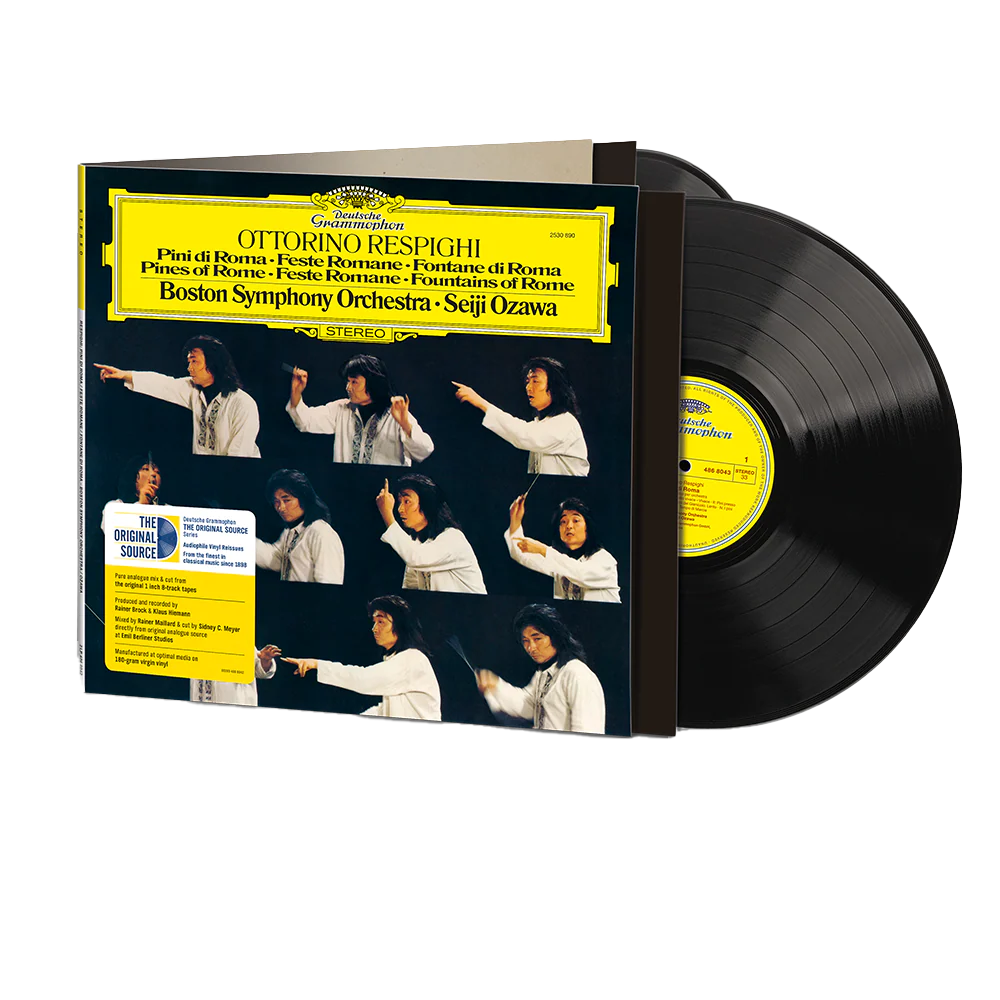
Boston Symphony Orchestra, Seiji Ozawa: Respighi: Pines of Rome, P. 141; Roman Festivals, P. 157; Fountains of Rome, P. 106 (The Original Source Series) 2LP
No contemporary Italian was as successful an instrumental composer in the concert hall in the period after the First World War as Ottorino Respighi with his four-movement symphonic poems ‘Fountains Of Rome’ (1917), ‘Pines Of Rome’ (1924) and ‘Feste Romane’ (1929). In these works, programme music experienced a magnificent revival. Particularly noteworthy is Respighi's art of instrumentation, with which he rivaled orchestral composers such as Richard Strauss and Maurice Ravel. He made use of a musical language distilled from many sources, a kind of ‘Euro-Impressionism’ that did not exclude modernist influences.
By including the song of a real-life nightingale near the end of the third movement “I pini del Gianicolo” of his 1924 tone poem Pini di Roma, Ottorino Respighi famously composed the first orchestral piece to incorporate gramophone sounds. In the original score, the nightingale’s part is played on a gramophone, and Respighi specified the exact recording he wanted to be used: “Il canto dell’usignolo” from disc No. R. 6105 — the Italian release of one of a series of acoustic birdsong recordings made by Deutsche Grammophon audio pioneer Max Hampe at a Bremen aviary in 1910. When this Boston Symphony Orchestra recording was made (on 8-track analogue tape) in 1977, the nightingale’s song was not recorded during the orchestral sessions but added in from an additional tape when the 2-track master was mixed a few weeks later in Hanover. That additional tape is no longer in the archives. So, in preparing this new release for DG’s Original Source Series, producer Rainer Maillard decided to use one of Hampe’s original recordings (as chosen by Respighi himself), playing the 1910 shellac disc (matrix no. 7438r) on an acoustic gramophone in the Emil Berliner Studios’ echo chamber and mixing it in — in real time — while cutting.
LP 1
Side A
1. I pini di Villa Borghese
2. II. Pini presso una catacomba
3. III. I pini del Gianicolo
4. IV. I pini della Via Appia
Side B
1. I. Circenses
2. II. Il Giubileo
LP 2
Side C
1. III. L'Ottobrata
2. IV. La Befana
3. I. The Valle Giulia Fountain at Dawn
4. II. The Triton Fountain in the Morning
5. III. The Trevi Fountain at Midday
6. IV. The Villa Medici Fountain at Sunset
Product Information
Product Information
Shipping & Returns
Shipping & Returns
Description
No contemporary Italian was as successful an instrumental composer in the concert hall in the period after the First World War as Ottorino Respighi with his four-movement symphonic poems ‘Fountains Of Rome’ (1917), ‘Pines Of Rome’ (1924) and ‘Feste Romane’ (1929). In these works, programme music experienced a magnificent revival. Particularly noteworthy is Respighi's art of instrumentation, with which he rivaled orchestral composers such as Richard Strauss and Maurice Ravel. He made use of a musical language distilled from many sources, a kind of ‘Euro-Impressionism’ that did not exclude modernist influences.
By including the song of a real-life nightingale near the end of the third movement “I pini del Gianicolo” of his 1924 tone poem Pini di Roma, Ottorino Respighi famously composed the first orchestral piece to incorporate gramophone sounds. In the original score, the nightingale’s part is played on a gramophone, and Respighi specified the exact recording he wanted to be used: “Il canto dell’usignolo” from disc No. R. 6105 — the Italian release of one of a series of acoustic birdsong recordings made by Deutsche Grammophon audio pioneer Max Hampe at a Bremen aviary in 1910. When this Boston Symphony Orchestra recording was made (on 8-track analogue tape) in 1977, the nightingale’s song was not recorded during the orchestral sessions but added in from an additional tape when the 2-track master was mixed a few weeks later in Hanover. That additional tape is no longer in the archives. So, in preparing this new release for DG’s Original Source Series, producer Rainer Maillard decided to use one of Hampe’s original recordings (as chosen by Respighi himself), playing the 1910 shellac disc (matrix no. 7438r) on an acoustic gramophone in the Emil Berliner Studios’ echo chamber and mixing it in — in real time — while cutting.
LP 1
Side A
1. I pini di Villa Borghese
2. II. Pini presso una catacomba
3. III. I pini del Gianicolo
4. IV. I pini della Via Appia
Side B
1. I. Circenses
2. II. Il Giubileo
LP 2
Side C
1. III. L'Ottobrata
2. IV. La Befana
3. I. The Valle Giulia Fountain at Dawn
4. II. The Triton Fountain in the Morning
5. III. The Trevi Fountain at Midday
6. IV. The Villa Medici Fountain at Sunset